

Understanding how to get clients for a construction company in Nigeria requires more than running social media pages, posting photographs of completed buildings, or depending on referrals from previous clients. Construction is a high-trust, high-value industry where potential clients often evaluate a contractor’s technical capability, previous projects, pricing approach, professionalism, project management systems, consultants, workforce, regulatory understanding, financial capacity, and ability to deliver before awarding a project.
At Scalabu Digital, we help businesses build measurable digital client acquisition systems using SEO, paid advertising, content marketing, conversion optimisation, lead generation, analytics, and digital strategy. For construction companies, however, successful acquisition also requires understanding how property owners, developers, consultants, corporate organisations, procurement teams, architects, investors, and other project stakeholders actually select contractors.
Therefore, construction marketing should not be treated like marketing for a low-cost consumer service.
A homeowner planning a residential duplex may begin with Google, Instagram, TikTok, YouTube, referrals, or Nairaland. Meanwhile, a developer planning an estate may rely more heavily on consultants, previous project experience, capability statements, technical proposals, procurement processes, tender submissions, and professional relationships.
Similarly, an organisation seeking a commercial contractor may evaluate several companies before requesting proposals, conducting site meetings, reviewing technical capacity, and negotiating commercial terms.
Consequently, the strongest construction client acquisition strategy combines search visibility, project authority, digital advertising, professional relationships, tenders, referrals, content marketing, consultant networks, website conversion, and disciplined sales follow-up.
Table of Contents
- Strategy 1: SEO Optimisation
- Strategy 2: Construction Content Marketing
- Strategy 3: Google Ads
- Strategy 4: Facebook, Instagram and TikTok Ads
- Strategy 5: Project Portfolio and Construction Authority
- Strategy 6: LinkedIn and B2B Construction Marketing
- Strategy 7: Referral and Consultant Relationships
- Strategy 8: Developer, Architect and Industry Partnerships
- Strategy 9: Tenders, Procurement and Project Bidding
- Strategy 10: Construction Directories, Listings and Off-Page Authority
- Strategy 11: Website Conversion and Project Enquiry Optimisation
- Strategy 12: Construction Lead Qualification and Proposal Conversion
- Strategy 13: Client Retention, Project Reactivation and Referrals
- Strategy 14: Measure and Optimise Construction Client Acquisition
- Bringing the Client Acquisition Strategies Together
- Grow Your Construction Company With Scalabu Digital
- Frequently Asked Questions
Strategy 1: SEO Optimisation
Search engine optimisation can become one of the strongest long-term acquisition channels for construction companies because many prospective clients begin their contractor search online.
However, construction SEO should not begin with publishing random blog posts.
Instead, it should begin with understanding which projects the company actually wants to win.
Identify the Type of Construction Clients You Want
Not all construction clients have the same requirements.
Potential segments include:
- Individual homeowners
- High-net-worth individuals
- Property developers
- Real estate companies
- Corporate organisations
- Hotels and hospitality businesses
- Schools and universities
- Healthcare organisations
- Industrial companies
- Retail businesses
- Government agencies
- NGOs
- Religious organisations
- Architects
- Engineering firms
- Facility managers
- Property investors
A company seeking residential projects in Lekki requires a different strategy from a contractor pursuing warehouse construction, hotel development, public infrastructure, or commercial office projects.
Therefore, first identify:
- Preferred project types
- Minimum project value
- Geographic coverage
- Ideal client type
- Construction specialisation
- Project capacity
- Typical project duration
- Whether the company handles design, construction, or both
This makes every subsequent marketing decision more focused.
Position the Construction Company Around Specific Project Needs
Generic statements such as:
We provide quality construction services
or
We build your dreams
do very little to differentiate one company from another.
Instead, positioning should communicate:
- What the company builds
- Who it builds for
- Where it operates
- Project scale
- Technical expertise
- Delivery model
- Specific problems it solves
For example:
We provide residential design-and-build services for property owners and developers in Lagos, managing projects from pre-construction planning through structural works, finishing, and handover.
A commercial contractor might position itself differently:
We help businesses, developers, and institutional clients execute commercial construction and fit-out projects with structured project management, consultant coordination, quality control, and cost oversight.
The more precise the positioning, the easier it becomes for prospective clients to determine whether the company is relevant to their project.
Target High-Intent Construction Keywords
A key part of learning how to get clients for a construction company in Nigeria is understanding the difference between general construction searches and commercial-intent searches.
Examples of potentially valuable searches include:
- Construction company in Lagos
- Construction company in Nigeria
- Building contractor in Lagos
- Construction company in Abuja
- House construction company in Lagos
- Building contractor in Lekki
- Residential construction company in Nigeria
- Commercial construction company in Lagos
- Design and build company in Nigeria
- Renovation company in Lagos
- Hotel construction company
- Building contractor near me
- Construction company in Port Harcourt
- Construction company in Ikoyi
- Construction company in Victoria Island
Someone searching for “construction company in Lagos” may be closer to hiring than someone searching for “what is construction?”
Therefore, commercial service pages should target commercial search intent, while educational articles can capture earlier-stage research.
Create Separate Pages for Major Construction Services
Many construction company websites place every service on one page.
That approach limits both SEO relevance and conversion potential.
Instead, create dedicated pages for important services such as:
- Residential Construction
- Commercial Construction
- Industrial Construction
- Hotel Construction
- Design and Build
- Building Renovation
- Construction Project Management
- Structural Works
- Interior Fit-Out
- Sustainable Construction
- Facility Management
- Property Development Support
Each service page should explain:
- Who the service is for
- What the service includes
- Types of projects handled
- Construction process
- Relevant previous experience
- Geographic coverage
- Project enquiry process
- Clear next step
Consequently, the website can target a broader range of commercially relevant searches.
Build Industry-Specific Construction Pages
High-value commercial clients often search by project type rather than simply searching for a generic contractor.
Therefore, construction companies can create pages such as:
- Construction Services for Property Developers
- Hotel Construction Services
- Healthcare Facility Construction
- School Construction
- Office Construction
- Retail Construction
- Industrial Facility Construction
- Residential Estate Construction
These pages can address the specific requirements of each client category.
For example, a hotel developer may care about:
- Programme management
- MEP coordination
- Finishing quality
- Interior integration
- Procurement
- Safety
- Consultant coordination
- Handover timelines
Meanwhile, an industrial client may prioritise:
- Structural performance
- Safety
- Technical compliance
- Site logistics
- Operational continuity
- Engineering coordination
Therefore, industry-specific pages can demonstrate a deeper understanding of the client’s project environment.
Target Location-Based Construction Searches
Construction is geographically sensitive.
Someone developing property in Lagos will often prefer companies with local project knowledge, suppliers, labour relationships, logistics experience, and consultant networks.
Potential location pages include:
- Construction Company in Lagos
- Construction Company in Abuja
- Construction Company in Port Harcourt
- Construction Company in Lekki
- Construction Company in Ikoyi
- Construction Company in Victoria Island
- Construction Company in Ikeja
- Construction Company in Maitama
- Building Contractor in Asokoro
However, do not create dozens of almost identical pages.
Instead, each location page should contain meaningful local information, such as:
- Services available
- Types of projects handled
- Areas covered
- Construction considerations
- Relevant portfolio projects
- Local market experience
- Logistics considerations
That makes each page more useful to both users and search engines.
Improve On-Page SEO
Construction websites should optimise:
- SEO titles
- Meta descriptions
- Heading structure
- Focus keywords
- URLs
- Internal links
- Service-page content
- Image alt text
- Project descriptions
- Calls to action
- Search intent alignment
For example, an image labelled:
IMG_9382.jpg
provides very little context.
A more descriptive filename could be:
residential-construction-project-lekki-lagos.jpg
Likewise, the accompanying project page should explain what was actually delivered rather than presenting photographs without context.
Improve Technical SEO and Website User Experience
Construction websites frequently contain:
- Large site photographs
- Drone footage
- Architectural renders
- Project videos
- Interactive galleries
- PDF brochures
Unfortunately, these assets can make the website slow.
Therefore, technical optimisation should address:
- Page speed
- Mobile responsiveness
- Core Web Vitals
- Image compression
- Video optimisation
- Crawlability
- Indexability
- XML sitemap
- HTTPS
- Broken links
- Website architecture
- Navigation
- Internal linking
- Structured data
Furthermore, potential clients should be able to find important information quickly.
A visitor should not have to search through several pages to find:
- Services
- Projects
- Company profile
- Contact details
- Project enquiry form
- Certifications
- Locations served
Technical SEO and user experience should therefore support each other.
Strengthen Local SEO
For companies targeting local and regional projects, Google Business Profile can strengthen visibility.
Maintain accurate:
- Business name
- Telephone number
- Website
- Office location
- Service areas
- Opening hours
- Construction categories
- Photographs
Additionally, upload authentic:
- Project photographs
- Construction progress
- Site images
- Completed buildings
- Team photographs
Reviews can also strengthen trust.
Where genuine clients are willing to leave feedback, useful reviews may reference:
- Professionalism
- Construction quality
- Communication
- Project management
- Timeliness
- Problem-solving
- Responsiveness
Use Off-Page SEO to Build Authority
Construction companies can strengthen digital authority through:
- Property publications
- Architecture websites
- Engineering platforms
- Supplier websites
- Business publications
- Contractor directories
- Project features
- Digital PR
- Interviews
- Expert commentary
- Relevant backlinks
For instance, if an architecture firm publishes a completed project and credits the contractor with a link, that can contribute to both industry visibility and SEO authority.
Strategy 2: Construction Content Marketing
Construction clients ask many questions before appointing a contractor.
Therefore, content marketing gives construction companies an opportunity to answer those questions while demonstrating expertise.
Publish Content Prospective Construction Clients Search For
Potential topics include:
- How much does it cost to build a house in Nigeria?
- Cost of building a duplex in Lagos
- How much does it cost to build a 4-bedroom duplex?
- How to choose a construction company in Nigeria
- Questions to ask a building contractor
- Design-build vs traditional construction
- How long does it take to build a house?
- Stages of building construction
- Common construction mistakes in Nigeria
- How to avoid construction cost overruns
- How to select building materials
- Construction project management checklist
- How to budget for a building project
- Renovation cost in Lagos
- What to know before starting a construction project
These articles attract people before they are necessarily ready to award a project.
However, useful content can move them closer to considering the company.
Create Construction Cost and Budget Content
Cost is one of the biggest concerns for prospective construction clients.
Therefore, content can address:
- Building material costs
- Labour
- Structural works
- Foundation
- Roofing
- Mechanical and electrical works
- Finishing
- Renovation
- Professional fees
- Contingency
- Project management
However, avoid presenting estimates as permanent fixed prices.
Construction costs vary based on:
- Location
- Project specification
- Building size
- Material quality
- Design complexity
- Exchange rates
- Labour
- Procurement conditions
- Site access
- Soil conditions
- Finishing standard
Instead, educate the reader about the variables affecting cost.
That builds credibility while avoiding unrealistic promises.
Build Content Around Different Client Journey Stages
Awareness
At this stage, the prospect is learning.
Relevant content includes:
- Construction guides
- Building costs
- Planning checklists
- Building stages
- Material comparisons
Consideration
The prospect is comparing approaches and contractors.
Useful topics include:
- How to choose a contractor
- Design-build vs separate consultants
- Contractor selection criteria
- Construction company red flags
- How construction contracts work
- How to prevent cost overruns
Decision
The prospect may now evaluate individual companies.
Content should include:
- Service pages
- Project portfolio
- Construction case studies
- Testimonials
- Company capability
- Project consultation pages
- Request-a-quote pages
Therefore, the website should contain content for more than one stage of the buying journey.
Build Topical Authority Around Priority Services
If residential construction is a priority, create content clusters around:
- Building costs
- Foundation
- Roofing
- Finishing
- Materials
- Timelines
- Contractor selection
- Construction planning
For commercial construction, topics might include:
- Project management
- Procurement
- Fit-outs
- Construction scheduling
- Contractor mobilisation
- Cost control
- Consultant coordination
- Risk management
This creates deeper topical relevance.
Repurpose Website Articles on LinkedIn and Nairaland
Publishing an article should not be the end of the content process.
Construction companies can repurpose website content into formats suitable for platforms where prospective clients already spend time.
For example, an article titled:
How Much Does It Cost to Build a 4-Bedroom Duplex in Lagos?
could become:
- A LinkedIn post explaining major construction cost drivers
- A LinkedIn carousel showing the major building stages
- A Nairaland discussion on the factors affecting duplex construction costs
- An Instagram carousel
- A TikTok educational video
- A short Facebook post
- A WhatsApp educational update
- An email to previous project enquiries
For LinkedIn, content should lean towards professional insight.
Examples include:
- Project management lessons
- Construction risk
- Cost control
- Developer considerations
- Procurement
- Commercial construction
- Project case studies
For Nairaland, content should be adapted to the platform’s conversational style.
Useful topics can include:
- Building costs
- Contractor selection
- Construction experiences
- Material choices
- Property development
- Renovation
- Construction mistakes
The objective should not be to copy and paste the full website article.
Instead, extract useful insights, start meaningful discussions, and direct interested readers to the company’s website where appropriate.
Create Useful Lead Magnets
Potential resources include:
- Construction Budget Checklist
- Contractor Selection Checklist
- Residential Building Planning Guide
- Renovation Planning Checklist
- Construction Project Preparation Checklist
- Questions to Ask Before Hiring a Contractor
These resources can capture potential clients earlier in the decision process.
Strategy 3: Google Ads
Google Ads can be especially valuable for construction companies because it allows businesses to reach people already searching for contractors.
Potential searches include:
- Construction company near me
- Building contractor in Lagos
- House construction company Lagos
- Construction company Abuja
- Renovation company Lagos
- Commercial contractor Lagos
- Design and build company Nigeria
- Building company Lekki
Separate Campaigns by Construction Service
Avoid sending every keyword into one generic campaign.
Instead, consider separating campaigns by:
- Residential Construction
- Commercial Construction
- Renovation
- Design and Build
- Interior Fit-Out
- Construction Project Management
This allows for more relevant:
- Keywords
- Advertisement copy
- Landing pages
- Conversion messaging
Match Search Intent With Landing Pages
Someone searching:
Residential construction company in Lagos
should ideally land on a relevant residential construction page.
Likewise:
Office renovation company Lagos
should reach a renovation or commercial fit-out page.
A generic homepage may force the prospect to search for the information they need.
Therefore, a more focused journey is:
High-Intent Google Search
↓
Relevant Construction Advertisement
↓
Relevant Service Page
↓
Project Enquiry
Use Negative Keywords
Depending on campaign goals, irrelevant searches may include:
- Construction jobs
- Construction training
- Construction courses
- Civil engineering school
- Construction salary
- Construction internship
- Free house plans
- DIY building
- Construction certification
Negative keywords can reduce wasted advertising spend.
Track Construction Enquiries, Not Only Clicks
Important conversions may include:
- Phone calls
- WhatsApp enquiries
- Project enquiry forms
- Site inspection requests
- Consultation bookings
- Quote requests
- Qualified project leads
- Proposal requests
Ultimately, the objective is not simply website traffic.
It is profitable construction opportunities.
Strategy 4: Facebook, Instagram and TikTok Ads
Paid social advertising can support construction client acquisition, particularly for visually driven project categories.
However, the channel should be matched to the type of construction client.
Use Facebook and Instagram Ads for Residential and Property-Focused Campaigns
Meta advertising can be useful for:
- Residential construction
- Luxury homes
- Renovation
- Interior fit-outs
- Property development
- Design-and-build services
Potential creative assets include:
- Before-and-after projects
- Construction progress
- Completed buildings
- Drone footage
- Interior transformations
- Site walkthroughs
- Architectural renders
Instead of showing only a completed building, tell the project story.
For example:
Initial Site
↓
Foundation
↓
Structural Works
↓
Finishing
↓
Completed Property
↓
Request a Project Consultation
Use TikTok Ads Selectively
TikTok can be relevant to construction, particularly where the work is visually compelling.
Examples include:
- Residential construction
- Renovations
- Luxury homes
- Interior fit-outs
- Property development
- Design-and-build
Useful content formats include:
- Construction time-lapses
- Foundation-to-finish transformations
- Site progress
- Property walkthroughs
- Material comparisons
- Construction mistakes
- Building-cost explanations
- Before-and-after renovations
However, TikTok should not necessarily be treated as the primary acquisition channel for large industrial, infrastructure, institutional, or tender-driven projects.
Those projects are more likely to depend heavily on:
- Professional relationships
- Procurement
- Consultants
- Tenders
- Technical proposals
- Previous project evidence
Therefore, TikTok should support the construction company’s wider acquisition mix rather than being forced into every campaign.
Use Retargeting
Retarget people who have:
- Visited construction service pages
- Viewed portfolio projects
- Read building-cost articles
- Watched construction videos
- Visited renovation pages
- Engaged with social media
- Started but not completed an enquiry
This helps keep the business visible during what can be a long decision-making process.
Strategy 5: Project Portfolio and Construction Authority
For construction companies, the portfolio is not simply a gallery.
It is evidence.
A potential client wants to know:
Can this company actually deliver a project like mine?
Build a Strong Construction Portfolio
Each project should ideally explain:
- Project type
- Location
- Project scope
- Building size
- Client category
- Construction services provided
- Project duration
- Key challenges
- Solutions
- Progress
- Final outcome
Avoid uploading photographs without context.
Instead of:
Project 01
use something more informative such as:
Residential Duplex Construction in Lekki, Lagos
Then explain what the company delivered.
Publish Construction Case Studies
A useful case study structure could be:
Project
↓
Client Objective
↓
Project Scope
↓
Challenge
↓
Construction Approach
↓
Execution
↓
Outcome
For example:
Project Objective
Deliver a residential duplex within the client’s required programme while maintaining the agreed design intent and finishing standard.
Challenge
The site required careful logistics planning, multiple vendor coordination, and staged procurement.
Approach
The contractor developed the construction programme, coordinated site activities, managed trades, supervised quality control, and maintained regular project reporting.
Outcome
The completed project demonstrated the company’s ability to coordinate residential construction through multiple phases.
This communicates far more than a set of photographs.
Show Construction Progress
Progress documentation can include:
- Site preparation
- Foundation
- Structural frame
- Blockwork
- Roofing
- MEP installation
- Finishing
- External works
- Handover
This gives prospective clients evidence that the company understands the complete construction process.
Showcase Technical and Professional Capability
Where genuine and applicable, show:
- Professional qualifications
- Industry memberships
- Safety credentials
- Technical team
- Engineering capability
- Project managers
- Consultants
- Licences
- Certifications
However, only publish credentials the company actually holds.
Strategy 6: LinkedIn and B2B Construction Marketing
LinkedIn deserves its own construction strategy because commercial construction is heavily relationship-driven.
Potential clients and influencers may include:
- Property developers
- CEOs
- Real estate executives
- Facility managers
- Project managers
- Procurement managers
- Architects
- Engineers
- Quantity surveyors
- Operations managers
- Hospitality executives
- Investment companies
Publish Professional Construction Insights
Potential LinkedIn topics include:
- Project delivery lessons
- Construction cost control
- Common developer mistakes
- Design-build advantages
- Construction risk
- Procurement challenges
- Commercial fit-outs
- Project scheduling
- Site logistics
- Contractor selection
Rather than constantly posting:
We are available for construction projects
show expertise.
For example:
Three decisions property developers should make before appointing a contractor
is more useful and more likely to build professional authority.
Publish Project Case Studies on LinkedIn
A completed project can become:
- Short project overview
- Construction challenge
- Solution
- Photos
- Result
- Link to full website case study
This helps decision-makers understand the company’s experience without immediately visiting the website.
Connect With Relevant Decision-Makers
LinkedIn prospecting should be targeted rather than random.
Potential connections include:
- Developers
- Architects
- Consultants
- Real estate executives
- Facility managers
- Procurement professionals
However, avoid turning every new connection into an immediate sales pitch.
Build familiarity by:
- Sharing relevant content
- Commenting intelligently
- Engaging with industry discussions
- Publishing useful project insights
- Maintaining professional visibility
Strategy 7: Referral and Consultant Relationships
Construction projects frequently involve several professional advisers.
Therefore, referrals can come from much more than previous clients.
Build Relationships With Architects
Architects are often involved before a contractor is appointed.
Consequently, strong relationships with architectural firms can create:
- Referrals
- Tender invitations
- Design-build collaborations
- Contractor recommendations
- Joint opportunities
Build Relationships With Quantity Surveyors
Quantity surveyors may influence:
- Cost planning
- Procurement
- Contractor evaluation
- Tender analysis
- Commercial negotiations
Therefore, professional credibility with QS firms can matter significantly.
Build Relationships With Engineers
Potential partners include:
- Structural engineers
- Civil engineers
- Mechanical engineers
- Electrical engineers
These consultants may recommend contractors or become part of multidisciplinary project teams.
Encourage Previous Client Referrals
Residential clients may refer:
- Friends
- Family
- Colleagues
- Business partners
Corporate clients may refer the contractor across:
- Departments
- Subsidiaries
- Partner companies
- Professional networks
Therefore, every successfully delivered project can become a future acquisition asset.
Strategy 8: Developer, Architect and Industry Partnerships
Some of the most valuable construction opportunities come from relationships inside the wider property ecosystem.
Build Relationships With Property Developers
Property developers may require contractors for:
- Residential estates
- Apartment buildings
- Commercial properties
- Hospitality developments
- Mixed-use projects
However, developers usually want evidence of:
- Capacity
- Project management
- Cost discipline
- Quality
- Programme performance
- Previous experience
Therefore, construction companies should prepare professional materials that support these conversations.
Partner With Architectural Firms
Architectural firms can become valuable strategic partners, particularly when clients require integrated design and construction services.
Potential collaboration models include:
- Design-build
- Joint project pitches
- Contractor referrals
- Project delivery partnerships
Develop Relationships With Real Estate Companies
Real estate firms may encounter clients who require:
- New construction
- Renovation
- Property upgrades
- Commercial fit-outs
- Facility services
Therefore, mutually beneficial referral relationships can produce qualified opportunities.
Build Supplier and Vendor Relationships
Important partners may include:
- Cement suppliers
- Steel companies
- Roofing suppliers
- Tile suppliers
- Electrical suppliers
- Plumbing suppliers
- Aluminium companies
- Interior companies
- Equipment suppliers
Supplier relationships can support both project delivery and business development.
Strategy 9: Tenders, Procurement and Project Bidding
This is one of the major areas where construction client acquisition differs from many other service industries.
Commercial, institutional, government, development, and large private-sector projects may be awarded through formal procurement processes.
Therefore, construction companies seeking larger contracts should build a structured tender strategy.
Identify Relevant Project Opportunities
Potential opportunities may come through:
- Existing professional networks
- Developers
- Consultants
- Corporate procurement teams
- Public tenders
- Development organisations
- Main contractors seeking subcontractors
- Industry contacts
However, bidding for every available project is rarely efficient.
Instead, qualify opportunities based on:
- Project scope
- Location
- Contract value
- Technical requirements
- Competition
- Experience requirements
- Financial requirements
- Available capacity
- Probability of winning
Prepare a Strong Capability Statement
A construction capability statement may include:
- Company overview
- Core services
- Geographic coverage
- Technical team
- Relevant experience
- Selected projects
- Key differentiators
- Safety capability
- Quality processes
- Contact information
This should be professional, concise, and evidence-based.
Prepare for Contractor Prequalification
Some clients require contractors to meet minimum criteria before receiving tender documents.
Potential requirements may include:
- Company registration
- Financial information
- Tax documents
- Professional personnel
- Health and safety documentation
- Previous projects
- References
- Insurance
- Equipment
- Organisational structure
Therefore, keep important documentation organised and current.
Improve Technical Proposal Quality
A technical proposal may need to demonstrate:
- Understanding of the project
- Methodology
- Construction programme
- Site management approach
- Quality assurance
- Safety
- Team structure
- Risk management
- Relevant experience
Generic proposals weaken confidence.
Instead, tailor submissions to the specific project.
Strengthen Commercial Proposals
Price matters, but the lowest price does not automatically represent the strongest offer.
Commercial proposals should clearly communicate:
- Scope assumptions
- Pricing
- Exclusions
- Payment terms
- Programme
- Commercial conditions
Ambiguity can create problems later.
Track Tender Performance
Construction companies should record:
- Tenders identified
- Tenders qualified
- Submissions made
- Shortlists
- Interviews
- Wins
- Losses
- Reasons for loss
- Contract value
Over time, this reveals which opportunities are worth pursuing.
Strategy 10: Construction Directories, Listings and Off-Page Authority
Online listings can support both discoverability and SEO.
Potential categories include:
- Construction directories
- Contractor directories
- Business directories
- Property directories
- Architecture platforms
- Engineering platforms
- Local directories
However, quality matters.
Avoid submitting the company to hundreds of low-value directories simply to obtain links.
Maintain Consistent Business Information
Keep the following consistent:
- Company name
- Telephone
- Website
- Address
- Locations served
- Services
- Business description
Build Industry Mentions
Construction companies can also strengthen authority through:
- Project features
- Property publications
- Architecture articles
- Engineering content
- Expert interviews
- Developer partnerships
- Supplier features
- Digital PR
- Guest contributions
Strong off-page authority should reinforce the company’s real expertise.
Strategy 11: Website Conversion and Project Enquiry Optimisation
Traffic alone does not generate construction revenue.
The website needs to convert interested visitors into serious enquiries.
Create Clear Service Pages
Each page should answer:
- What does the company do?
- Who is the service for?
- What type of projects are handled?
- Where does the company operate?
- What does the process involve?
- What relevant projects have been completed?
- What should the prospect do next?
Build a Strong Portfolio
Organise projects into categories such as:
- Residential
- Commercial
- Hospitality
- Industrial
- Renovation
- Interior Fit-Out
- Design and Build
This allows prospects to quickly find relevant evidence.
Offer Clear Project Enquiry Options
Potential calls to action include:
- Discuss Your Construction Project
- Request a Project Consultation
- Request a Construction Quote
- Schedule a Site Assessment
- Speak With Our Construction Team
Make Contact Channels Easy to Find
Potential clients should easily access:
- Telephone
- Enquiry form
However, avoid asking twenty unnecessary questions at the first point of contact.
Capture enough information to understand the opportunity, then qualify further.
Strategy 12: Construction Lead Qualification and Proposal Conversion
Not every construction enquiry represents a viable project.
Therefore, companies need a structured qualification process.
Stage 1: New Project Enquiry
Capture:
- Name
- Company
- Telephone
- Project type
- Location
- Project size
- Lead source
Stage 2: Initial Qualification
Determine:
- Scope
- Budget range
- Location
- Timeline
- Land or site availability
- Design status
- Decision-maker
- Funding readiness
These questions help determine whether the opportunity is realistic.
Stage 3: Project Discovery
Understand:
- Project objective
- Design requirements
- Client expectations
- Consultants involved
- Construction scope
- Procurement approach
- Target completion date
- Key risks
Stage 4: Site Assessment or Consultation
Where appropriate, conduct a site assessment.
This can reveal:
- Site conditions
- Access
- Existing structures
- Logistics
- Utilities
- Potential constraints
Stage 5: Proposal
A professional construction proposal may include:
- Project understanding
- Scope
- Methodology
- Deliverables
- Programme
- Commercial terms
- Assumptions
- Next steps
Stage 6: Follow-Up
Construction decisions can take time.
Therefore, a prospect who has not responded after three days should not automatically be considered lost.
Use structured follow-up.
Stage 7: Won, Lost, Delayed or Cancelled
Track the final outcome.
If lost, record why.
Potential reasons include:
- Price
- Technical requirements
- Capacity
- Competitor relationship
- Timeline
- Financing
- Project cancellation
- Poor follow-up
- Proposal weakness
This information can improve future sales performance.
Strategy 13: Client Retention, Project Reactivation and Referrals
Construction acquisition should not end at project handover.
Stay Connected With Previous Clients
Previous clients may later require:
- Extensions
- Renovation
- Additional properties
- New branches
- Commercial projects
- Facility management
- Referrals
Therefore, maintain professional relationships after completion.
Reactivate Delayed Construction Leads
Many construction projects are delayed rather than permanently abandoned.
Reasons may include:
- Funding
- Approvals
- Design revisions
- Land documentation
- Market conditions
- Internal decision-making
- Material costs
Therefore, previous leads should be reviewed periodically.
A project discussed six months ago may now be ready to proceed.
Generate Referrals From Completed Projects
At project completion, satisfied clients can become powerful advocates.
Request:
- Testimonials
- Reviews
- Referrals
- Permission to publish case studies
A completed project can generate future business long after handover.
Strategy 14: Measure and Optimise Construction Client Acquisition
Without measurement, companies may continue investing in channels that generate activity but little revenue.
Track each major source.
Potential channels include:
- Organic Google Search
- Google Ads
- Facebook Ads
- Instagram Ads
- TikTok Ads
- Nairaland
- Referrals
- Architects
- Engineers
- Quantity surveyors
- Developers
- Tenders
- Directories
Then measure business outcomes.
Qualified Project Leads
How many enquiries represent genuine potential projects?
Consultation or Site Assessment Rate
How many qualified leads move to serious discussions?
Proposal Rate
How many opportunities receive proposals?
Project Win Rate
How many proposals turn into awarded projects?
Cost Per Lead
How much marketing spend is required to generate an enquiry?
Cost Per Qualified Lead
How much is required to generate a realistic construction opportunity?
Client Acquisition Cost
How much does it cost to win one new construction client?
Project Value by Acquisition Channel
Compare revenue or contract value from:
- SEO
- Google Ads
- Referrals
- Developers
- Architects
- Paid social
- Tenders
A channel producing fewer leads may actually be more valuable if those leads produce larger projects.
Return on Marketing Investment
The strongest acquisition channel is not necessarily the one generating the most:
- Followers
- Impressions
- Website visits
- WhatsApp messages
Instead, focus on channels that generate profitable construction contracts.
Bringing the Client Acquisition Strategies Together
Ultimately, how to get clients for a construction company in Nigeria should not be approached as a collection of disconnected tactics.
Instead, construction companies need an integrated acquisition system.
A stronger process can look like this:
1. Define the projects and clients you want
↓
2. Build SEO and local search visibility
↓
3. Publish construction content that answers client questions
↓
4. Capture active demand through Google Ads
↓
5. Use Facebook, Instagram and TikTok selectively for visual project discovery
↓
6. Build authority through project portfolios and case studies
↓
7. Develop LinkedIn and B2B visibility
↓
8. Build architect, engineer, QS and developer relationships
↓
9. Participate strategically in tenders and procurement opportunities
↓
10. Strengthen directories and off-page authority
↓
11. Convert website visitors into project enquiries
↓
12. Qualify opportunities and submit strong proposals
↓
13. Retain clients, reactivate delayed projects and generate referrals
↓
14. Measure results and invest more heavily in what produces profitable projects
Online Client Acquisition Process
A typical digital journey might look like:
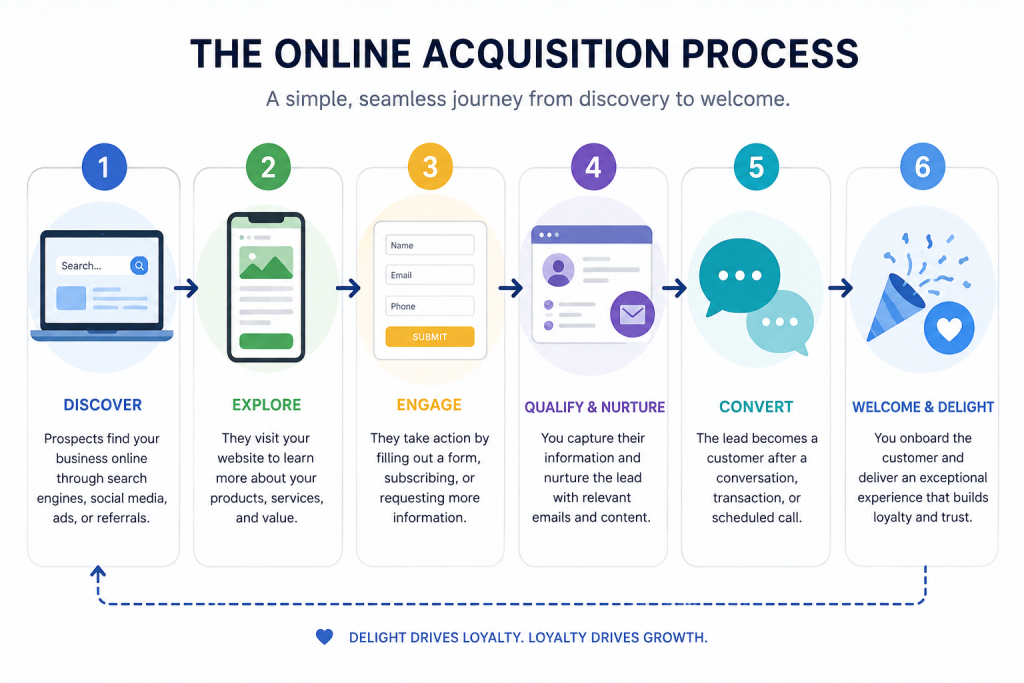
However, not every client follows a straight path.
For example, a developer might first discover the company through LinkedIn, later search its name on Google, review its projects, visit the website several times, speak with an architect who knows the company, and only then request a proposal.
Therefore, the objective is not simply to generate clicks.
It is to build enough visibility, authority, evidence, and trust across multiple touchpoints for serious prospects to move towards a project discussion.
Grow Your Construction Company With Scalabu Digital
Knowing how to get clients for a construction company in Nigeria ultimately requires an acquisition system that matches the complexity of the construction buying process.
SEO can help the business capture people already searching for contractors. Meanwhile, Google Ads can increase visibility for high-intent commercial searches. Construction content can answer questions around costs, project planning, materials, contractor selection, and project execution.
Additionally, LinkedIn can strengthen professional authority among developers, consultants, and corporate decision-makers. Facebook, Instagram and TikTok can showcase visually compelling residential and renovation projects, while strong project portfolios and case studies provide evidence that the company can actually deliver.
At Scalabu Digital, we specialise in helping businesses build connected, measurable digital acquisition systems. Our services include SEO, local SEO, technical SEO, Google Ads, paid social advertising, content marketing, social media marketing, conversion optimisation, lead generation, and analytics.
Therefore, if your construction company wants to increase digital visibility, attract more qualified project enquiries, strengthen its online authority, and build a more measurable client acquisition system, contact Scalabu Digital to discuss a strategy aligned with your target projects, locations, clients, and growth objectives.
Website: https://scalabudigital.com/
Phone: +234 9069231842
Email: info@scalabudigital.com
FAQs About How to Get Clients for a Construction Company in Nigeria
1. How can a construction company get more clients in Nigeria?
A construction company can attract more clients by combining SEO, Google Ads, project portfolios, LinkedIn marketing, referrals, developer relationships, consultant networks, tenders, paid social advertising, directories, content marketing, and structured lead follow-up. The right mix depends on whether the company targets residential, commercial, industrial, institutional, or developer-led projects.
2. How can I market my construction company in Nigeria?
Start by identifying the types of projects and clients you want. Then build dedicated service pages, optimise for relevant Nigerian construction searches, publish useful content, showcase completed projects, use Google Ads for high-intent searches, develop professional relationships, and create a structured process for converting enquiries into proposals and contracts.
3. Does SEO work for construction companies?
Yes. SEO can help construction companies appear when prospective clients search for contractors, residential construction companies, renovation companies, design-build firms, and location-specific construction services. Strong SEO should combine service pages, location pages, technical SEO, project case studies, content marketing, local SEO, and off-page authority.
4. How can a construction company get residential building projects?
Residential contractors can use local SEO, Google Ads, Instagram, Facebook, TikTok, Nairaland, referrals, real estate partnerships, useful building-cost content, and strong project portfolios. Before-and-after transformations, construction progress, completed homes, and cost-related educational content can be particularly useful for residential prospects.
5. Should construction companies use Google Ads?
Yes, particularly when potential clients are actively searching for construction services. However, campaigns should target commercially relevant keywords, separate important services, use dedicated landing pages, add negative keywords, and track qualified project enquiries rather than clicks alone.
6. Are Facebook and Instagram Ads effective for construction companies?
They can be particularly useful for residential construction, renovation, luxury homes, property development, and visually compelling design-build projects. Strong project photographs, progress videos, transformations, and site walkthroughs can help generate awareness and enquiries.
7. Are TikTok Ads relevant for construction companies?
TikTok Ads can be relevant for residential construction, renovations, property development, interior fit-outs, and other visually demonstrable services. However, they should generally be treated as a supporting acquisition channel rather than the primary method for securing large commercial, industrial, or tender-driven projects.
8. Should construction companies repurpose website articles on LinkedIn and Nairaland?
Yes. A website article can be converted into LinkedIn posts, carousels, Nairaland discussions, short videos, social-media posts, emails, and WhatsApp content. Repurposing extends the reach of the original article and can direct interested audiences back to relevant service or project pages.
9. What type of content should a construction company publish?
Useful topics include building costs, contractor selection, construction timelines, project planning, design-build, materials, cost overruns, renovation, commercial construction, property development, case studies, and completed project insights.
10. What should a construction company website include?
A strong construction website should contain service pages, location pages, a detailed project portfolio, construction case studies, company information, relevant credentials, testimonials, contact information, project enquiry forms, WhatsApp access, and clear calls to action.
11. What should be included in a construction project case study?
A case study should ideally explain the project type, location, client objective, scope, construction challenge, approach, project stages, services provided, duration where appropriate, photographs, and outcome. The purpose is to demonstrate capability rather than simply display images.
12. Can Scalabu Digital help construction companies generate more clients?
Yes. Scalabu Digital helps businesses build measurable acquisition systems using SEO, Google Ads, paid social advertising, content marketing, local SEO, conversion optimisation, lead generation, social media marketing, and analytics. For construction companies, these strategies can be aligned with target project types, locations, client segments, and commercial objectives.

