
Understanding how to get clients for an event planning business in Nigeria requires more than posting beautiful event pictures on Instagram, attending weddings, or depending on word-of-mouth referrals. Event planning is highly visual and relationship-driven; however, prospective clients still evaluate a planner’s creativity, organisation, reliability, portfolio, reviews, communication, vendor network, and ability to deliver before making a booking.
At Scalabu Digital, we help businesses build measurable client acquisition systems using SEO, Google Ads, content marketing, paid social advertising, social media strategy, conversion optimisation, and analytics. For event planning businesses, this means creating several pathways through which potential clients can discover the brand, experience its work, build confidence, request a consultation, and eventually book an event.
Moreover, the buying journey differs considerably depending on the type of event. Someone planning a wedding may spend weeks or months comparing planners, venues, decorators, photographers, and packages. Meanwhile, a company organising a conference or product launch may prioritise experience, responsiveness, budgeting, logistics, and the ability to coordinate several vendors efficiently.
Therefore, event planners should avoid relying on a single acquisition channel.
Instead, the strongest approach combines search visibility, visual content, paid advertising, referrals, strategic partnerships, social proof, strong website conversion, and consistent follow-up.
Table of Contents
- Strategy 1: SEO Optimisation
- Strategy 2: Content Marketing
- Strategy 3: Google Ads
- Strategy 4: Facebook, Instagram and TikTok Ads
- Strategy 5: Social Media and Visual Authority
- Strategy 6: Referral Marketing
- Strategy 7: Strategic Partnerships and Networking
- Strategy 8: Industry and Professional Directory Listings
- Strategy 9: Build Trust and Social Proof
- Strategy 10: Website Conversion Optimisation
- Strategy 11: Lead Follow-Up and Client Conversion
- Strategy 12: Client Retention and Reactivation
- Strategy 13: Measure and Optimise Client Acquisition
- Bringing the Client Acquisition Strategies Together
- Grow Your Event Planning Business With Scalabu Digital
- Frequently Asked Questions
Strategy 1: SEO Optimisation
Search engine optimisation can become one of the strongest long-term client acquisition channels for an event planning business because it allows the company to appear when potential clients are actively searching for planners, venues, wedding services, corporate event management, and related solutions.
However, SEO should begin with understanding the clients the business actually wants.
Identify the Type of Event Planning Clients You Want
Not every event planning business needs the same audience.
For example, possible client segments include:
- Wedding clients
- Corporate organisations
- Birthday clients
- Luxury event clients
- Schools
- Religious organisations
- NGOs
- Government organisations
- Product launch clients
- Conference organisers
- Brands
- Marketing agencies
- High-net-worth individuals
- Families organising private celebrations
Once the target audience is clear, marketing becomes significantly more focused.
For instance, wedding clients may care about:
- Venue selection
- Decoration
- Vendor coordination
- Guest experience
- Budget management
- Wedding timelines
- Bridal logistics
Meanwhile, corporate clients may prioritise:
- Professional event management
- Budget control
- Guest registration
- Brand execution
- Audio-visual coordination
- Conference logistics
- Security
- Vendor management
- Reporting
Therefore, the first question should not simply be:
How can we get more event clients?
Instead, ask:
Which type of event clients do we want more of?
Position the Event Planning Business Around Specific Client Needs
Many event businesses use similar positioning:
We create unforgettable events.
Making your special day memorable.
Turning your dreams into reality.
Although these statements sound appealing, they do not clearly communicate why one planner is better suited to a client’s needs than another.
Instead, positioning should explain:
- Type of events handled
- Target clients
- Location
- Level of service
- Planning expertise
- Specific problems solved
- Type of experience delivered
For example:
We help busy professionals plan elegant weddings in Lagos by managing venues, vendors, timelines, guest logistics, and on-the-day coordination from start to finish.
That statement is considerably clearer.
Similarly, a corporate event company might position itself as:
We plan and execute conferences, product launches, corporate dinners, and brand events for organisations that need reliable end-to-end event management.
Consequently, positioning makes both marketing and sales easier.
Target High-Intent Event Planning Keywords
One important part of learning how to get clients for an event planning business in Nigeria is understanding what prospective clients search for when they are already looking for a planner.
Examples include:
- Event planner in Lagos
- Event planning company in Nigeria
- Wedding planner in Lagos
- Corporate event planner in Abuja
- Birthday event planner
- Event management company in Lagos
- Luxury event planner in Nigeria
- Wedding planning services in Nigeria
- Corporate event management company
- Event planner near me
- Party planner in Lagos
- Conference planner in Nigeria
These searches often indicate stronger commercial intent than a general query such as:
How do I plan a birthday party?
Therefore, an event planning business should target both educational keywords and commercial keywords.
Use On-Page SEO to Improve Event Planning Visibility
On-page SEO covers the elements that can be optimised directly on the website.
These include:
- SEO titles
- Meta descriptions
- Headings
- Service-page copy
- URLs
- Internal links
- Image alt text
- Keywords
- Calls to action
- Portfolio descriptions
For event businesses, image optimisation is particularly important because websites often contain large galleries.
However, beautiful photographs alone provide limited search context.
Therefore, event images should have descriptive file names, relevant alt text, and supporting page content that explains the event type, service, theme, and location where appropriate.
Create Separate Pages for Major Event Planning Services
Avoid listing every service on one short page.
Instead, create dedicated pages for services such as:
- Wedding Planning
- Corporate Event Planning
- Birthday Party Planning
- Conference Planning
- Product Launch Events
- Private Event Planning
- Luxury Event Planning
- Event Coordination
- Venue Sourcing
- Vendor Management
- Event Decoration
- Event Logistics
Each page should explain:
- What the service includes
- Who it is for
- What problems it solves
- How the planning process works
- Why clients should trust the business
- How to request a consultation
As a result, the website can rank for a wider range of commercially relevant searches.
Target Location-Based Event Planning Searches
Location is particularly important for event services.
Potential keywords may include:
- Event Planner in Lagos
- Wedding Planner in Lekki
- Event Planner in Abuja
- Event Planner in Port Harcourt
- Event Planning Company in Victoria Island
- Corporate Event Planner in Ikeja
However, location pages should not simply duplicate the same content.
Instead, each page should discuss:
- Services available in the location
- Types of events commonly handled
- Venue knowledge
- Areas covered
- Relevant event logistics
- Local expertise
Consequently, local pages become more useful for people searching within specific markets.
Improve Technical SEO and Website User Experience
Event planning websites are often image-heavy.
Therefore, technical performance deserves particular attention.
Large photographs, uncompressed videos, sliders, and visual effects can make a website attractive while simultaneously slowing it down.
Unfortunately, prospective clients may leave before seeing the portfolio.
Therefore, event businesses should improve:
- Website speed
- Mobile responsiveness
- Core Web Vitals
- Image compression
- Video optimisation
- Crawlability
- Indexability
- XML sitemap
- HTTPS
- Broken links
- Website architecture
- Internal linking
- Navigation
- Structured data
Furthermore, most event clients will likely encounter the brand while using a mobile device.
Consequently, mobile usability should be treated as a priority.
Potential clients should quickly find:
- Portfolio
- Event services
- Reviews
- Contact information
- Consultation form
- Social media links
At Scalabu Digital, we approach technical SEO and UX together because attracting visitors to a website is not enough. The site must also make it easy for those visitors to explore the brand and take action.
Strengthen Local SEO
Google Business Profile can strengthen visibility for location-based event searches.
Therefore, keep information such as the following accurate:
- Business name
- Telephone number
- Website
- Office address where applicable
- Service areas
- Opening hours
- Event services
- Photos
Additionally, upload high-quality photographs from actual events.
Reviews can also strengthen confidence.
For instance, a client review mentioning communication, vendor coordination, event organisation, creativity, punctuality, or attention to detail can give future prospects useful information about the experience of working with the planner.
Use Off-Page SEO to Build Authority
Off-page SEO helps strengthen authority outside the event company’s website.
Potential strategies include:
- Wedding blog features
- Venue website mentions
- Vendor backlinks
- Event publication features
- Guest articles
- Digital PR
- Business directories
- Event directories
- Interviews
- Brand mentions
For example, when a venue publishes photos from a wedding and credits the event planner with a link to the planner’s website, the event business gains both visibility and a potentially relevant backlink.
Similarly, collaborations with photographers, decorators, caterers, hotels, and wedding platforms can create valuable online mentions.
Strategy 2: Content Marketing
Content marketing helps event planners attract potential clients before those prospects are ready to book.
Instead of publishing only photographs of completed events, the business can also answer questions people ask during the planning process.
Publish Content Potential Event Clients Are Searching For
Potential topics include:
- How much does an event planner cost in Nigeria?
- How to choose a wedding planner
- Wedding planning checklist
- How to plan a wedding in Lagos
- How to choose an event venue
- Questions to ask an event planner
- How early should you hire a wedding planner?
- Corporate event planning checklist
- How to plan a product launch
- How to create an event budget
- Event planning mistakes to avoid
- How to choose event vendors
- How many months does it take to plan a wedding?
These topics allow potential clients to discover the business during the research phase.
More importantly, they give the planner an opportunity to demonstrate expertise.
Build Content Around Different Stages of the Client Journey
Event clients move through several stages before booking.
Awareness
The prospect begins researching the event.
Potential content:
- Event planning checklists
- Venue guides
- Budgeting tips
- Planning timelines
Consideration
The prospect begins comparing options.
Potential content:
- Event planner vs DIY planning
- How much does a wedding planner cost?
- Full planning vs coordination
- How to choose an event planner
Decision
The prospect is considering specific providers.
Relevant content includes:
- Service pages
- Portfolio
- Reviews
- Case studies
- Consultation page
- Pricing guidance
Consequently, content can support the entire decision-making process.
Build Topical Authority Around Your Major Event Services
A wedding planner could build a content cluster around:
- Wedding budgets
- Wedding venues
- Vendor selection
- Decoration
- Timelines
- Guest management
- Bridal logistics
- Wedding themes
Meanwhile, a corporate event company could publish around:
- Conferences
- Product launches
- Corporate dinners
- Award ceremonies
- Brand activations
- Employee events
- Retreats
Over time, this helps the brand become associated with specific event categories.
Repurpose Website Content Across LinkedIn, Nairaland and Social Media
Publishing an article on the event planning company’s website should not be the end of the content distribution process.
Instead, useful website content can be repurposed into platform-specific formats.
For example, an article titled “How Much Does a Wedding Planner Cost in Lagos?” could become:
- A LinkedIn post explaining the major factors affecting wedding planning costs
- A LinkedIn carousel summarising the planning process
- A Nairaland discussion answering common event-planning questions
- An Instagram carousel
- A TikTok video
- A short Facebook post
- An email newsletter
- A WhatsApp educational post
LinkedIn can be especially useful for repurposing corporate event planning content, while Nairaland can provide an additional distribution channel for useful discussions around weddings, event costs, venues, vendors, and event planning in Nigeria.
Rather than copying the website article word-for-word, adapt the content to each platform and direct interested readers back to the website for more detailed information.
Create Useful Lead Magnets
Useful resources can help turn anonymous visitors into potential leads.
Examples include:
- Wedding Planning Checklist
- Event Budget Template
- Corporate Event Planning Checklist
- Venue Selection Checklist
- Vendor Checklist
- Wedding Planning Timeline
For instance, someone downloading a wedding checklist may not be ready to book immediately.
However, the business can continue nurturing that prospect through helpful communication.
Strategy 3: Google Ads
SEO builds long-term visibility. However, Google Ads can help event planners reach people who are actively looking for services now.
Potential search terms include:
- Event planner near me
- Wedding planner Lagos
- Event planning company Lagos
- Corporate event planner Nigeria
- Birthday planner Lagos
- Luxury wedding planner Nigeria
- Event management company Abuja
Because these searches indicate existing demand, paid search can become an effective acquisition channel.
Separate Campaigns by Event Type
Avoid placing every event service inside one campaign.
Instead, separate campaigns by commercial intent.
For example:
- Wedding Planning Campaign
- Corporate Events Campaign
- Birthday Planning Campaign
- Luxury Events Campaign
- Conference Planning Campaign
This allows the business to create more relevant:
- Keywords
- Ad copy
- Landing pages
- Calls to action
Match Every Advertisement With the Right Landing Page
Someone searching:
Wedding planner in Lagos
should land on a wedding planning page.
Likewise:
Corporate event planner
should lead to a corporate events page.
Meanwhile:
Birthday party planner
should reach a birthday planning page.
This creates a more consistent customer journey:
Search
↓
Relevant Advertisement
↓
Relevant Service Page
↓
Enquiry
Use Negative Keywords to Reduce Wasted Spend
Depending on campaign objectives, irrelevant searches may include:
- Event planning jobs
- Event planning courses
- Event management salary
- Event planning training
- Free event planning templates
- Event management degree
- Event planner certification
Negative keywords help reduce traffic from users who are unlikely to become clients.
Track Event Enquiries Instead of Clicks
Traffic alone does not tell the full story.
Instead, track:
- Phone calls
- WhatsApp enquiries
- Contact forms
- Consultation bookings
- Quote requests
- Qualified leads
- Confirmed event bookings
At Scalabu Digital, we focus on connecting advertising activity to actual enquiries and customer acquisition rather than judging campaigns primarily by impressions and clicks.
Strategy 4: Facebook, Instagram and TikTok Ads
Paid social media is particularly relevant for event planning because event experiences are highly visual.
Unlike Google Search, where someone usually expresses existing demand, Facebook, Instagram and TikTok can help create demand by showing people what an event could look like.
Use Visual Campaigns to Showcase Event Experiences
Potential ad creatives include:
- Wedding highlights
- Venue transformations
- Before-and-after decoration
- Corporate events
- Birthday setups
- Luxury tablescapes
- Behind-the-scenes footage
- Guest reactions
- Event planning processes
Instead of simply saying:
Book us for your event
show the transformation.
For example:
Empty Venue
↓
Setup Process
↓
Finished Event
↓
Guest Experience
↓
Book a Consultation
That tells a stronger story.
Use Facebook and Instagram Ads to Reach Relevant Audiences
Meta advertising can be useful for reaching potential audiences based on campaign objectives and available targeting options.
Depending on the event type, this may include people interested in:
- Weddings
- Bridal services
- Events
- Luxury experiences
- Business
- Hospitality
- Corporate activities
Corporate campaigns may also focus more heavily on retargeting, lookalike audiences, and first-party audience data rather than broad lifestyle interests.
Use TikTok Ads to Create Event Discovery
TikTok can be particularly useful for visually compelling event content.
Instead of creating advertisements that feel like traditional commercials, event businesses can develop short-form creative showing:
- Venue transformations
- Wedding setup
- Behind-the-scenes planning
- Before-and-after decoration
- Event breakdown
- Planning mistakes
- Vendor coordination
- Event highlights
For example:
POV: You hired an event planner and arrived at this venue transformation.
Short-form storytelling can generate interest before the prospect has actively searched for a planner.
Consequently, TikTok Ads can complement Google Search by creating awareness earlier in the customer journey.
Use Retargeting Across Paid Social Campaigns
Not everyone will book after the first interaction.
Therefore, retarget people who have:
- Visited the website
- Viewed service pages
- Watched event videos
- Engaged with Instagram content
- Visited portfolio pages
- Submitted an incomplete form
- Downloaded a planning guide
For instance, someone who watched a wedding highlight video could later see a consultation-focused advertisement.
As a result, the brand remains visible while the prospect continues considering options.
Promote Educational Resources
Paid social campaigns can also promote:
- Wedding checklists
- Budget guides
- Event planning templates
- Corporate event guides
- Venue selection resources
- Webinar registrations
Therefore, Facebook, Instagram and TikTok Ads do not have to focus exclusively on direct booking campaigns.
They can also generate leads earlier in the funnel.
Strategy 5: Social Media and Visual Authority
An event planning business sells something that potential clients naturally want to see.
Consequently, social media should function as more than an announcement channel.
It should become a living portfolio.
Use Instagram to Showcase Your Event Portfolio
Useful Instagram content includes:
- Finished event photographs
- Reels
- Venue transformations
- Before-and-after setups
- Client reactions
- Decor details
- Planning tips
- Vendor collaborations
- Behind-the-scenes content
- Event highlights
For example, instead of uploading ten unrelated wedding photographs, create a story around the event:
Client Vision
↓
Venue Before Setup
↓
Planning Process
↓
Final Transformation
↓
Guest Experience
This demonstrates the planner’s role rather than simply showing pretty photographs.
Use TikTok for Organic Event Discovery
TikTok can also support organic visibility.
Useful content formats include:
- Day in the life of an event planner
- Wedding setup time-lapse
- Event planning mistakes
- Vendor coordination
- Behind-the-scenes logistics
- Venue transformations
- Budget tips
- Event breakdowns
- Client reactions
The objective is not merely to follow trends.
Instead, trends can be adapted to showcase expertise and execution.
Use LinkedIn to Attract Corporate Event Clients
LinkedIn should play a different role.
Rather than focusing mainly on weddings and private celebrations, event companies can use LinkedIn to build authority around corporate event management.
Relevant content might include:
- Conference planning
- Corporate dinners
- Employee events
- Brand activations
- Product launches
- Event logistics
- Guest management
- Event ROI
- Corporate event budgeting
Potential decision-makers include:
- CEOs
- Marketing managers
- HR leaders
- Brand managers
- Communications teams
- Operations managers
- Executive assistants
Consequently, LinkedIn can become an important corporate business-development channel.
Repurpose Event Content Across Relevant Platforms
One event can generate several content assets.
For example:
One Corporate Conference
could become:
- Instagram Reel
- TikTok transformation video
- LinkedIn case study
- Nairaland discussion
- Blog article
- Email content
- Carousel
- Portfolio page
- Short client testimonial
Therefore, every event should also be considered a content-production opportunity.
Strategy 6: Referral Marketing
Referrals remain one of the strongest client acquisition channels in event planning.
After all, people often ask friends, colleagues, family members, venues, photographers, decorators, and other vendors for recommendations.
However, referrals should not be left entirely to chance.
Encourage Referrals From Happy Clients
Excellent event delivery naturally creates recommendations.
Wedding clients may refer:
- Friends
- Siblings
- Colleagues
- Family members
Meanwhile, corporate clients may refer the planner to other departments, partner companies, or professional contacts.
Therefore, client experience affects future acquisition.
Build a Structured Referral System
Record:
- Who referred the prospect
- Type of event
- Date
- Booking outcome
- Revenue generated
Over time, the business can identify its strongest referral sources.
Furthermore, staying in touch with good referral partners helps maintain those relationships.
Maintain Relationships With Previous Clients
A wedding client may later require:
- Birthday planning
- Anniversary planning
- Baby shower planning
- Family celebrations
- Corporate events
Therefore, a completed event should not necessarily represent the end of the relationship.
Strategy 7: Strategic Partnerships and Networking
Event businesses operate within an ecosystem of vendors.
Therefore, strategic partnerships can become a powerful acquisition channel.
Build Vendor Partnerships
Potential partners include:
- Event venues
- Hotels
- Caterers
- Decorators
- Photographers
- Videographers
- DJs
- MCs
- Makeup artists
- Fashion designers
- Florists
- Bakers
- Rental companies
- Entertainment providers
For example, when a couple asks a wedding venue:
Can you recommend a planner?
the venue’s answer can generate business.
Likewise, photographers, decorators, caterers, and bridal vendors receive similar questions.
Therefore, trusted vendor relationships can create consistent referrals.
Build Corporate Partnerships
For corporate event acquisition, potential partners may include:
- Marketing agencies
- PR firms
- HR consultancies
- Corporate travel providers
- Hotels
- Conference centres
- Business consultants
- Training companies
For example, a PR agency organising a product launch for a client may require an event management partner.
Consequently, partnership-building can create access to projects the event business may not have discovered independently.
Attend Relevant Networking Events
Useful opportunities may include:
- Wedding fairs
- Business conferences
- SME events
- Hospitality exhibitions
- Corporate networking sessions
- Industry exhibitions
- Vendor events
However, networking should not simply involve distributing business cards.
Instead, focus on building relationships with potential clients and referral partners.
Host Educational Events
An event planning business can also build authority through:
- Webinars
- Workshops
- Wedding planning sessions
- Corporate event seminars
- Budgeting sessions
For instance:
How to Plan a Beautiful Wedding Without Losing Control of Your Budget
can attract prospective wedding clients while demonstrating expertise.
Strategy 8: Industry and Professional Directory Listings
Directories can support both discoverability and off-page SEO.
Potential platforms may include:
- Wedding directories
- Event vendor directories
- Venue directories
- Business directories
- Local directories
- Industry marketplaces
However, quality matters more than quantity.
Avoid submitting the business to hundreds of low-quality websites simply to obtain backlinks.
Instead, prioritise platforms potential clients genuinely use.
Maintain Consistent Business Information
Keep information consistent across listings:
- Business name
- Website
- Telephone number
- Location
- Service areas
- Event categories
- Business description
- Portfolio
This supports trust and reduces confusion.
Build Quality Backlinks and Event Brand Mentions
Event planners can also earn links and mentions through:
- Wedding blog features
- Event publication features
- Venue collaborations
- Vendor collaborations
- Interviews
- Digital PR
- Event case studies
- Guest articles
For instance, if a major event publication features one of the company’s weddings, that mention can strengthen both brand visibility and off-page SEO.
Strategy 9: Build Trust and Social Proof
Event clients are often paying significant amounts of money for experiences that happen once.
Therefore, trust is critical.
Build a Strong Event Portfolio
A portfolio should show more than random photographs.
Where possible, explain:
- Event type
- Venue
- Theme
- Number of guests
- Planning scope
- Design concept
- Final result
This helps prospects understand what the event planning business actually delivered.
Publish Event Case Studies
Case studies can follow a simple format.
The Client
A corporate organisation planning a major product launch.
The Objective
Create an event that introduced the product while delivering a strong guest and brand experience.
The Challenge
Coordinate venue, vendors, branding, entertainment, guest registration, and logistics within a fixed timeline.
The Approach
The planning team developed the event timeline, coordinated vendors, managed setup, supervised guest logistics, and oversaw event execution.
The Outcome
The event was delivered according to the agreed scope while providing the client with a coordinated end-to-end planning experience.
Case studies make the planning process visible.
Use Genuine Reviews and Testimonials
Strong reviews can discuss:
- Communication
- Organisation
- Creativity
- Reliability
- Vendor management
- Budget management
- Attention to detail
- Event execution
Potential clients want reassurance that the planner will not disappear, miss deadlines, or create unnecessary stress.
Therefore, testimonials should address the actual anxieties clients have.
Showcase Relevant Partnerships
Where appropriate, showcase genuine collaborations with:
- Venues
- Hotels
- Photographers
- Caterers
- Brands
- Corporate organisations
- Vendors
This can further strengthen credibility.
Strategy 10: Website Conversion Optimisation
Getting people to the website is only the beginning.
The website needs to convert those visitors into enquiries.
Optimise Event Service Pages for Enquiries
Each service page should answer:
- What service is offered?
- Who is it for?
- What does the package include?
- What problems does the planner solve?
- What previous experience is relevant?
- How does the planning process work?
- What should the prospect do next?
Create a Strong Portfolio Page
Potential clients should be able to browse previous:
- Weddings
- Corporate events
- Birthdays
- Conferences
- Product launches
- Private celebrations
- Luxury events
Furthermore, organise the portfolio by event type where possible.
This makes it easier for prospects to find work similar to what they want.
Offer a Clear Entry Point
The first step could be:
- Event Consultation
- Wedding Planning Consultation
- Corporate Event Brief
- Event Budget Review
- Venue Planning Consultation
Reducing uncertainty can improve enquiry rates.
Use Clear Calls to Action
Examples include:
Plan Your Event With Us
Request an Event Consultation
Get an Event Planning Quote
Discuss Your Wedding
Speak With an Event Planner
Calls to action should appear throughout relevant pages rather than only at the bottom.
Make Phone, Forms and WhatsApp Easy to Find
For many clients, WhatsApp may be the easiest first contact channel.
Therefore, allow prospects to reach the business without unnecessary friction.
However, every enquiry should be captured systematically.
Strategy 11: Lead Follow-Up and Client Conversion
A lead is not yet a client.
Therefore, event planning businesses need a structured enquiry process.
Stage 1: New Enquiry
Capture:
- Name
- Event type
- Event date
- Event location
- Estimated guest size
- Contact information
- Lead source
Stage 2: Initial Qualification
Determine:
- Budget range
- Event requirements
- Date availability
- Planning scope
- Decision-maker
This prevents the team from investing excessive time in leads that do not fit the business.
Stage 3: Event Discovery
Understand:
- Client vision
- Theme
- Venue
- Vendors required
- Guest experience
- Key priorities
- Expected planning support
Stage 4: Consultation
Use the consultation to understand the event in greater detail.
Additionally, explain how the planning process works.
Stage 5: Event Proposal
The proposal may include:
- Scope
- Deliverables
- Planning package
- Timeline
- Pricing
- Terms
- Next steps
Stage 6: Follow-Up
Not every prospect will respond immediately.
Therefore, follow up professionally.
A strong lead may simply be comparing several planners.
Stage 7: Booking or Closed Opportunity
Record whether the opportunity was:
- Won
- Lost
- Delayed
- Cancelled
Most importantly, record why.
Possible reasons include:
- Pricing
- Date conflict
- Budget mismatch
- Competitor selection
- Weak follow-up
- Lack of trust
- Service mismatch
Over time, this information improves both marketing and sales.
Strategy 12: Client Retention and Reactivation
Event planning may appear primarily transaction-based, but previous clients can generate considerable future business.
Stay Connected With Previous Clients
A wedding client might later require:
- Anniversary planning
- Baby shower
- Birthday event
- Family celebration
- Corporate event
Meanwhile, a corporate client may have recurring:
- Conferences
- Product launches
- Employee events
- End-of-year parties
- Brand activations
Therefore, client retention matters.
Reconnect With Old Leads
Some prospects did not reject the business.
They may have:
- Postponed the event
- Changed the date
- Reduced the budget
- Paused planning
- Chosen not to proceed at that time
Therefore, appropriate follow-up may reactivate previous opportunities.
Use Email and WhatsApp Marketing to Stay Visible
Share:
- Recent events
- Planning tips
- Event checklists
- Seasonal inspiration
- New services
- Venue ideas
- Corporate planning insights
However, avoid overwhelming clients with promotional messages.
Instead, maintain useful communication.
Strategy 13: Measure and Optimise Client Acquisition
Without measurement, an event planning business may spend heavily on marketing without knowing which channels generate actual bookings.
Therefore, track:
- Organic Google Search
- Google Ads
- Facebook Ads
- Instagram Ads
- TikTok Ads
- Instagram organic
- TikTok organic
- Referrals
- Vendor partnerships
- Directories
- Networking
Then measure performance.
Qualified Leads
How many enquiries match the type of events the business wants?
Consultation Rate
How many qualified enquiries become consultations?
Booking Conversion Rate
How many consultations become confirmed bookings?
Cost Per Lead
How much does each enquiry cost?
Cost Per Qualified Lead
How much marketing investment is required to generate a relevant prospect?
Customer Acquisition Cost
How much does the business spend to acquire one paying event client?
Revenue by Acquisition Channel
Which channels produce the most revenue?
For example:
Google Ads
vs.
Instagram Ads
vs.
Referrals
vs.
Vendor Partnerships
Return on Marketing Investment
Ultimately, the strongest channel is not necessarily the one producing the most likes, views, clicks, or enquiries.
Instead, it is the channel producing profitable event bookings at an acceptable acquisition cost.
Bringing the Client Acquisition Strategies Together
Ultimately, how to get clients for an event planning business in Nigeria should not be treated as a collection of unrelated tactics.
Instead, every strategy should support the next.
A connected acquisition system could look like this:
1. Define the type of event clients you want
↓
2. Build SEO and local search visibility
↓
3. Publish useful event planning content
↓
4. Capture immediate demand with Google Ads
↓
5. Create demand through Facebook, Instagram and TikTok Ads
↓
6. Build visual authority through social media
↓
7. Generate referrals and strategic vendor partnerships
↓
8. Strengthen directory presence and off-page authority
↓
9. Build trust through portfolios, reviews and case studies
↓
10. Convert website visitors into enquiries
↓
11. Follow up with qualified prospects
↓
12. Retain and reactivate clients
↓
13. Measure, optimise and scale what works
Online Client Acquisition Process
A typical online acquisition journey could look like this:
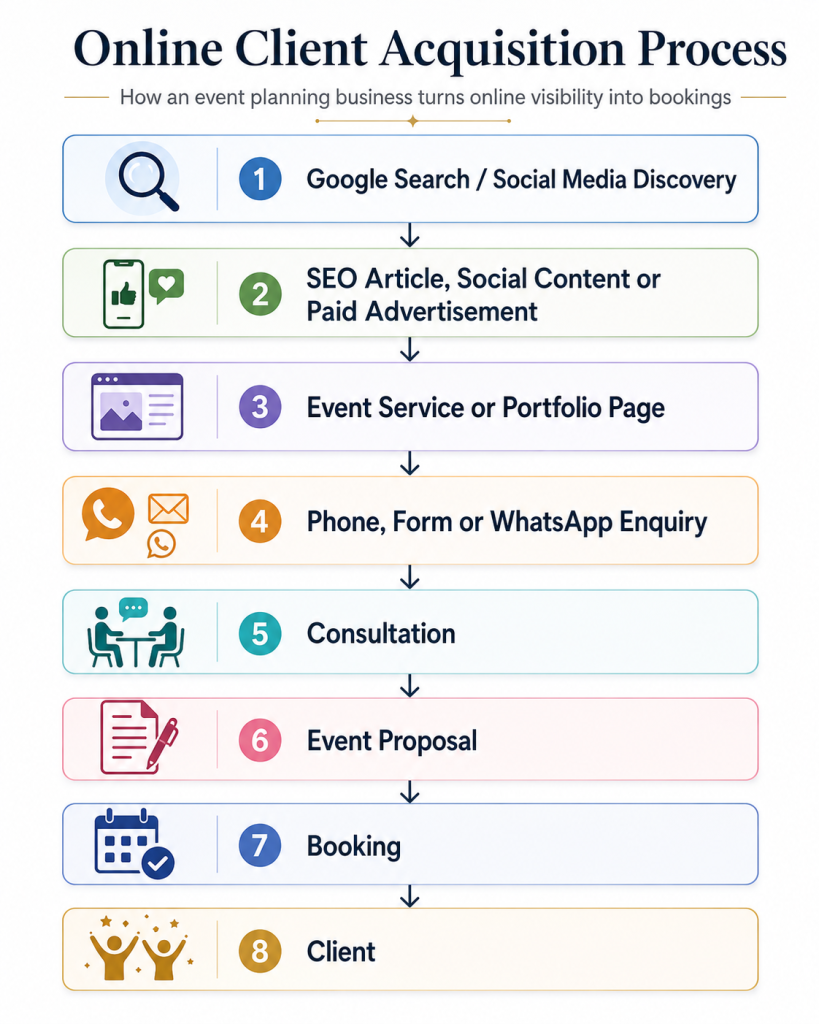
The important point is that several channels can feed the same conversion journey.
A client might discover the business through TikTok, later search for it on Google, explore the portfolio on the website, read reviews, follow the Instagram page, and only then request a consultation.
Therefore, successful client acquisition often requires multiple digital touchpoints.
Grow Your Event Planning Business With Scalabu Digital
Knowing how to get clients for an event planning business in Nigeria ultimately means building an acquisition system that turns visibility into enquiries and enquiries into bookings.
SEO can capture people already searching for event planners. Meanwhile, Google Ads can accelerate high-intent visibility. Facebook, Instagram and TikTok Ads can create demand and retarget interested audiences, while organic social media can showcase the quality of previous events.
At the same time, content marketing can answer prospective clients’ questions, vendor partnerships can generate referrals, and a strong portfolio can build confidence. Conversion optimisation can then make it easier for interested prospects to request consultations, while analytics can reveal which marketing channels actually produce bookings.
At Scalabu Digital, we specialise in helping businesses build measurable digital marketing and client acquisition systems. Our services include SEO, local SEO, technical SEO, Google Ads management, Facebook and Instagram advertising, content marketing, social media marketing, conversion optimisation, lead generation strategy, and analytics.
If your event planning business wants to attract more qualified clients, strengthen its digital visibility, and create a more predictable booking pipeline, contact Scalabu Digital to develop a client acquisition strategy aligned with your services, target clients, market, and growth objectives.
Website: https://scalabudigital.com/
Phone: +234 9069231842
Email: info@scalabudigital.com
FAQs About How to Get Clients for an Event Planning Business in Nigeria
1. How can an event planner get more clients in Nigeria?
An event planner can attract more clients by combining SEO, Google Ads, Facebook, Instagram and TikTok advertising, visual social media content, referrals, vendor partnerships, directories, strong reviews, conversion-focused service pages, and structured lead follow-up.
2. How can I market my event planning business in Nigeria?
Start by identifying the type of events and clients you want, then build marketing around those audiences. Use SEO for search visibility, visual platforms such as Instagram and TikTok to showcase previous work, Google Ads to capture high-intent searches, partnerships for referrals, and a strong website to convert interested prospects into enquiries.
3. Does SEO work for event planning businesses?
Yes. SEO can help event planning companies become visible when people search for wedding planners, corporate event planners, party planners, event management companies, and location-based event services. Strong SEO should combine service pages, location pages, local SEO, useful content, technical SEO, internal linking, and off-page authority.
4. Should event planners use Google Ads?
Google Ads can be particularly useful for reaching people already searching for event planning services. However, campaigns should target high-intent keywords, separate different event types, use relevant landing pages, apply negative keywords, and track enquiries and bookings instead of clicks alone.
5. Are TikTok Ads relevant for event planning businesses?
Yes. Event planning is highly visual, which makes TikTok suitable for showcasing venue transformations, event setups, behind-the-scenes planning, finished events, client reactions, and short educational content. TikTok Ads can be used for discovery, lead generation, retargeting, and increasing awareness among relevant audiences.
6. How can event planners use Instagram and TikTok to get clients?
Event planners can use Instagram and TikTok to showcase event transformations, behind-the-scenes planning, completed setups, client reactions, planning tips, vendor coordination, and short-form event stories. Paid ads can then amplify strong creative and retarget people who have already interacted with the brand.
7. How can an event planning business get corporate clients?
Corporate event planners should build specialised corporate service pages, use LinkedIn to reach decision-makers, target relevant Google searches, build relationships with PR and marketing agencies, attend business events, partner with hotels and conference venues, and publish corporate event case studies.
8. How can event planners generate more referrals?
Deliver an excellent client experience, maintain relationships with previous clients, build strong partnerships with venues and vendors, and track where referrals originate. Photographers, decorators, caterers, hotels, DJs, makeup artists, and other vendors can become valuable referral sources.
9. What should an event planning website include?
An event planning website should include clear service pages, a strong portfolio, client reviews, event case studies, information about the planning process, contact details, WhatsApp or enquiry options, location information, and clear calls to action.
10. Can Scalabu Digital help event planning businesses generate more clients?
Yes. Scalabu Digital helps businesses build measurable acquisition systems using SEO, Google Ads, paid social advertising, content marketing, social media marketing, conversion optimisation, local SEO, lead generation, and analytics. For event planning businesses, these strategies can be tailored to target event types, locations, audiences, and booking goals.

